
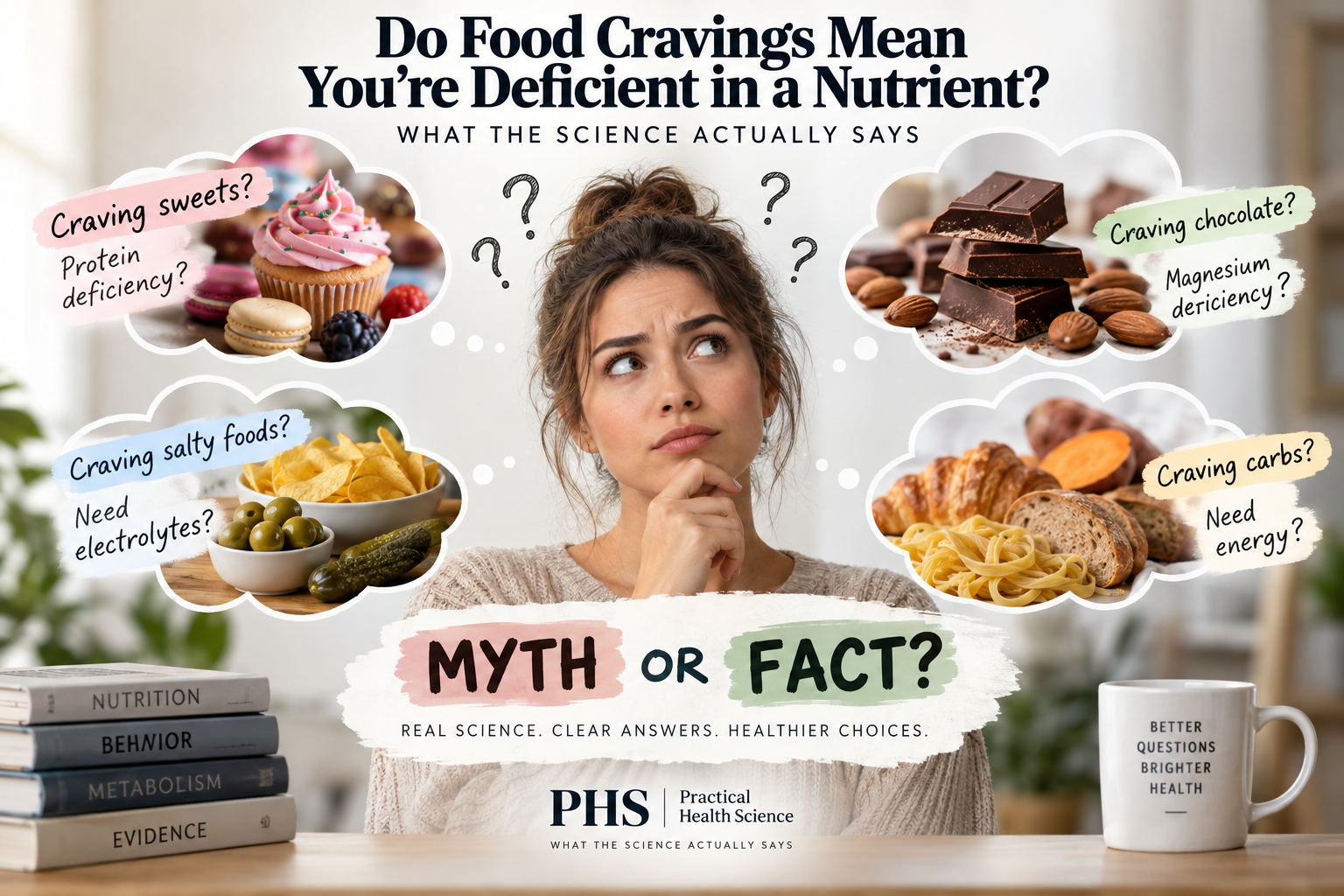
Do Food Cravings Mean You’re Deficient in a Nutrient?

Does craving chocolate mean low magnesium, or craving salt mean you need electrolytes? Here’s what science actually says about food cravings and nutrient deficiencies.

By Practical Health Science Editorial Team Sep 6, 2026 7 min read
Evidence Strength
Moderate

This rating reflects the overall strength and consistency of the available evidence.

Do Food Cravings Mean You’re Deficient in a Nutrient?
Quick Answer

Probably not.

Craving a specific food is generally not a reliable way to diagnose a specific nutrient deficiency.

Your body does have systems that help regulate energy and certain nutrients. Sodium depletion, for example, can produce a genuine appetite for salt, and research suggests that humans also regulate protein intake to some extent.

But that does not mean:

sugar craving = protein deficiency
salt craving = electrolyte deficiency
chocolate craving = magnesium deficiency
carb craving = energy deficiency

Everyday food cravings are influenced by a much broader mix of hunger, food reward, learned associations, dietary restriction, sensory cues, habits, and individual physiology.

So there is some real biology behind nutrient specific appetite but the viral “craving chart” is far more precise than the evidence allows.

What the Science Says

Food cravings are real physiological and psychological experiences, but they are not the same thing as laboratory tests for nutrient status.

A craving is usually defined as an intense desire to consume a particular food. Research suggests that cravings involve multiple systems, including hunger and energy regulation, reward processing, sensory experience, learned associations, and environmental food cues.

A 2026 systematic review of 23 studies that measured cravings repeatedly during everyday life found a consistent relationship between hunger and food craving. Cravings also appeared to predict subsequent eating.

That supports an intuitive idea: being hungry can make cravings stronger.

But it does not establish that craving one particular food tells us which nutrient the body lacks.

The distinction matters because some nutrient-specific appetite systems really do exist.

The question is whether they work as neatly as social media claims.

They usually do not.

Claim 1: “If You Crave Sweets, Your Body Needs Protein”

Verdict: Plausible biology, misleading conclusion.

There is legitimate research behind the concept of a protein-specific appetite.

The protein leverage hypothesis proposes that humans regulate protein intake relatively strongly. When the proportion of protein in the diet becomes lower, people may consume more total food in an attempt to reach a protein target.

Experimental and observational research provides support for some degree of protein regulation in humans.

That makes the underlying biology interesting.

But it does not establish a diagnostic rule in which wanting cookies, candy, or dessert means you are protein deficient.

A sweet food provides many signals simultaneously: sweetness, energy, sensory pleasure, reward, learned expectations, and often combinations of sugar and fat.

A craving for that food cannot currently tell us which of those mechanisms produced the desire.

PHS verdict: There is evidence that protein intake influences appetite and total energy intake. There is not good evidence that a sweet craving specifically signals protein deficiency.


Claim 2: “If You Crave Salt, You Need Electrolytes”

Verdict: Sometimes biologically plausible but not a general rule.

This claim has the strongest physiological foundation of the four.

Sodium is tightly regulated because it is essential for fluid balance, nerve function, and many other physiological processes.

When the body becomes genuinely sodium depleted, hormonal and neural systems can increase sodium appetite. Research on sodium deficiency shows that true sodium depletion can increase motivation to consume salty substances.

So, under certain circumstances substantial sodium loss being the important example salt appetite can reflect a physiological need.

But there is an important catch.

Salt is also highly palatable, and modern diets often contain abundant sodium. Learned preferences, habitual intake, and the rewarding properties of salty foods can influence how much salt people want independently of an actual deficiency.

And “electrolytes” is broader than sodium. Craving salty food cannot tell you that you are deficient in potassium, magnesium, or some generic category called electrolytes.

PHS verdict: True sodium depletion can increase salt appetite. An everyday craving for chips, olives, or pickles does not automatically mean you need electrolytes.


Claim 3: “If You Crave Chocolate, You Need Magnesium”

Verdict: Popular claim, weak evidence.

Chocolate contains magnesium. That fact probably helps explain why this idea sounds convincing.

But a food containing a nutrient does not mean craving that food diagnoses deficiency of that nutrient.

Chocolate is an unusually rewarding food because of its combination of taste, aroma, texture, sweetness, fat, and learned associations.

Research on chocolate craving has long pointed toward its sensory and hedonic properties as major contributors. Chocolate cravings can also vary with context and, in some women, across the menstrual cycle.

The magnesium explanation has been proposed, but evidence has not established chocolate craving as a useful marker of magnesium deficiency.

There is also a simple conceptual problem: many foods contain substantial magnesium, including nuts, seeds, legumes, and leafy greens.

If magnesium deficiency reliably generated a magnesium-specific appetite, it is not clear why the signal should consistently manifest as a desire for chocolate rather than other magnesium-containing foods.

PHS verdict: Chocolate can contribute dietary magnesium. Craving chocolate is not evidence that you have a magnesium deficiency.


Claim 4: “If You Crave Carbs, Your Body Needs Energy”

Verdict: Partly plausible, but far too simplistic.

Energy status does influence eating behavior.

The 2026 systematic review of real world craving studies found that hunger and craving tend to rise together within individuals. So someone who has eaten too little may indeed experience stronger food cravings.

Carbohydrate-rich foods also provide readily available dietary energy.

But this does not make a craving for bread, pastries, pizza, or other carbohydrate-rich foods a specific biological test for energy deficiency.

Food cravings can occur even when immediate energy needs are not unusually high. They are also influenced by palatability, conditioning, food availability, restriction, time of day, and exposure to food-related cues.

Interestingly, research on dietary restriction also challenges another common assumption. Short-term avoidance of a particular food can increase craving for that food, while longer-term calorie restriction in some populations has actually been associated with reduced cravings.

The relationship between energy balance and craving is therefore not a simple “low energy → carb craving” switch.

PHS verdict: Hunger and insufficient food intake can increase cravings, but craving carbohydrates does not specifically prove that your body is energy deficient.


Why the “Craving = Deficiency” Idea Is So Convincing

The viral explanation contains just enough real physiology to sound scientific.

The body does regulate nutrients.

Sodium deficiency can produce sodium appetite.

Protein intake appears to be biologically regulated.

Hunger influences craving.

And foods such as chocolate really do contain nutrients such as magnesium.

The problem occurs in the next step:

“The body regulates nutrients” becomes “every specific food craving identifies a specific nutrient deficiency.”

The evidence does not support that leap.

Food choice happens in an environment filled with highly palatable foods, learned associations, smells, advertising, habits, cultural preferences, and repeated exposure.

In fact, experimental research shows that even food-related odors can increase sensory-specific appetite and craving demonstrating that a craving can be generated or intensified by an external cue without a corresponding nutrient deficiency.

Cravings are therefore better understood as the output of multiple interacting biological and psychological systems, not as a nutritional warning code.

Limitations Summary

Research on food cravings has several important limitations.

Cravings are subjective and difficult to measure objectively. Many studies rely on questionnaires or self reported momentary craving.

Even the recent 2026 systematic review found that most real world studies did not measure cravings for specific foods in enough detail to determine precisely what participants wanted.

Evidence also differs substantially between mechanisms. Sodium appetite during true sodium depletion has a much stronger physiological basis than claims linking chocolate craving to magnesium deficiency.

Finally, evidence that humans regulate nutrients such as protein does not prove that people can consciously identify those needs through cravings for particular foods.

This makes broad “craving charts” scientifically unreliable even when individual parts of them contain plausible physiology.

What This Means in Real Life

You do not need to decode every craving as a hidden nutrient message.

If you occasionally want chocolate, something sweet, bread, or salty food, the craving itself is not enough to conclude that you have a nutritional deficiency.

Instead, look at the larger pattern.

Regular meals containing adequate protein, fiber rich carbohydrates, healthy fats, fruits, vegetables, and sufficient overall energy are more useful nutritional signals than trying to interpret individual cravings.

Context matters too.

Ask whether you are actually hungry, whether you have been restricting a particular food, whether the craving appeared after seeing or smelling food, or whether it tends to occur repeatedly at the same time or in the same situation.

And if you are concerned about a genuine nutrient deficiency because of persistent symptoms, dietary restriction, a medical condition, or other risk factors, assessment by a healthcare professional is more informative than using cravings as a diagnostic test.

Key Takeaway

Your body can regulate certain nutrients and energy needs but food cravings are not a nutritional diagnostic code.

Of the popular claims, salt craving during genuine sodium depletion has the clearest physiological basis, while the chocolate-magnesium connection is much weaker.

Sweet cravings do not reliably mean you need protein, and carbohydrate cravings do not automatically mean your body is short on energy.

The science points to a more complex explanation:

Cravings emerge from an interaction between hunger, nutrient regulation, reward, sensory cues, learning, habits, and environment.

That may be less catchy than a viral craving chart.

But it is much closer to what the evidence actually shows.

Sources

Ecological momentary assessment studies on food craving among healthy adults: A systematic review
Daiil Jun, Sydney Kong, Gayeon Lee, Tera L Fazzino. Appetite. 2026.
Systematic Review DOI: 10.1016/j.appet.2026.108721 PMID: 42456898

Primary contemporary evidence on food cravings in everyday life; supports the relationship between hunger and craving while highlighting limitations in food-specific craving measurement.

The Psychology of Food Cravings: the Role of Food Deprivation
Adrian Meule. Current Nutrition Reports. 2020.
Systematic Review DOI: 10.1007/s13668-020-00326-0 PMID: 32578025

Supports the discussion of conditioned cravings, selective food avoidance, and the complex relationship between dietary restriction and craving.

Protein appetite as an integrator in the obesity system: the protein leverage hypothesis
David Raubenheimer, Stephen J Simpson. Philosophical Transactions of the Royal Society B: Biological Sciences.. 2023.
Systematic Review DOI: 10.1098/rstb.2022.0212 PMID: 37661737

Main evidence source for protein-specific appetite and the protein leverage hypothesis; explains why protein regulation is biologically plausible without supporting “sweet craving = protein deficiency.”

Testing protein leverage in lean humans: a randomised controlled experimental study
Alison K Gosby, Arthur D Conigrave, Namson S Lau, Miguel A Iglesias, Rosemary M Hall, Susan A Jebb, Jennie Brand-Miller, Ian D Caterson, David Raubenheimer, Stephen J Simpson. PLoS ONE. 2011.
Randomized Controlled Trial DOI: 10.1371/journal.pone.0025929 PMID: 22022472

Experimental human evidence supporting protein leverage and the influence of dietary protein concentration on energy intake.

Salt craving: the psychobiology of pathogenic sodium intake
Michael J Morris, Elisa S Na, Alan Kim Johnson. Physiology & Behavior. 2008.
Systematic Review DOI: 10.1016/j.physbeh.2008.04.008 PMID: 18514747

Explains physiological sodium appetite as well as learned and reward-related influences on excessive salt intake.

The biopsychology of salt hunger and sodium deficiency
Seth W Hurley, Alan Kim Johnson. Pflügers Archiv – European Journal of Physiology. 2015.
Systematic Review DOI: 10.1007/s00424-014-1676-y PMID: 25572931

Main mechanistic source for the claim that genuine sodium deficiency can activate hormonal, neural, motivational, and reward systems that promote salt intake.

Chocolate craving and liking
P Rozin, E Levine, C Stoess. Appetite. 1991.
Observational Study DOI: 10.1016/0195-6663(91)90022-K PMID: 1799282

Classic human evidence on chocolate craving; supports the importance of sensory properties and demonstrates that chocolate craving is more complex than a simple nutrient-deficiency signal.

Chocolate: food or drug?
K Bruinsma, D L Taren. Journal of the American Dietetic Association. 1999.
Systematic Review DOI: 10.1016/S0002-8223(99)00307-7 PMID: 10524390

Reviews proposed explanations for chocolate craving, including sensory/hedonic properties, psychoactive components, mood-related mechanisms, and the hypothesized magnesium connection. The magnesium explanation is presented as a hypothesis rather than an established diagnostic relationship.

Effects of food-related odors on eating behavior: A systematic review
Jiachun Li, Xinmeng Yang, Rene de Wijk, Arianne van Eck, Sanne Boesveldt. Appetite. 2026.
Systematic Review DOI: 10.1016/j.appet.2026.108570 PMID: 42061514

Supports the role of external sensory cues in appetite and food craving, demonstrating why cravings cannot be interpreted solely as signals of internal nutrient deficiency.

Medical disclaimer: This article is for educational purposes only and does not provide medical advice, diagnosis, or treatment. Always consult a qualified healthcare professional for personal medical decisions.

More from Metabolic Health

Explore more Practical Health Science articles from this category.

Metabolic Health Myth Check Evidence: Moderate

Do Artificial Sweeteners Spike Insulin or Cause Weight Gain?

Artificial and other non-nutritive sweeteners generally do not produce a meaningful acute insulin or glucose spike on their own. They may modestly help with weight control when they replace sugar, but long-term observational studies remain harder to interpret.

Practical Health Science Editorial Team 6 min read Sep 4, 2026
Metabolic Health Explainer Evidence: Limited

Are Continuous Glucose Monitors Useful If You Don’t Have Diabetes?

Continuous glucose monitors are increasingly marketed to people without diabetes as tools for personalized nutrition and metabolic health. They can reveal glucose patterns and may encourage behavior change, especially in people at higher metabolic risk. But for healthy adults, evidence that CGMs improve long-term health remains limited.

Practical Health Science Editorial Team 9 min read Sep 3, 2026