
Metabolic Health Evidence Brief

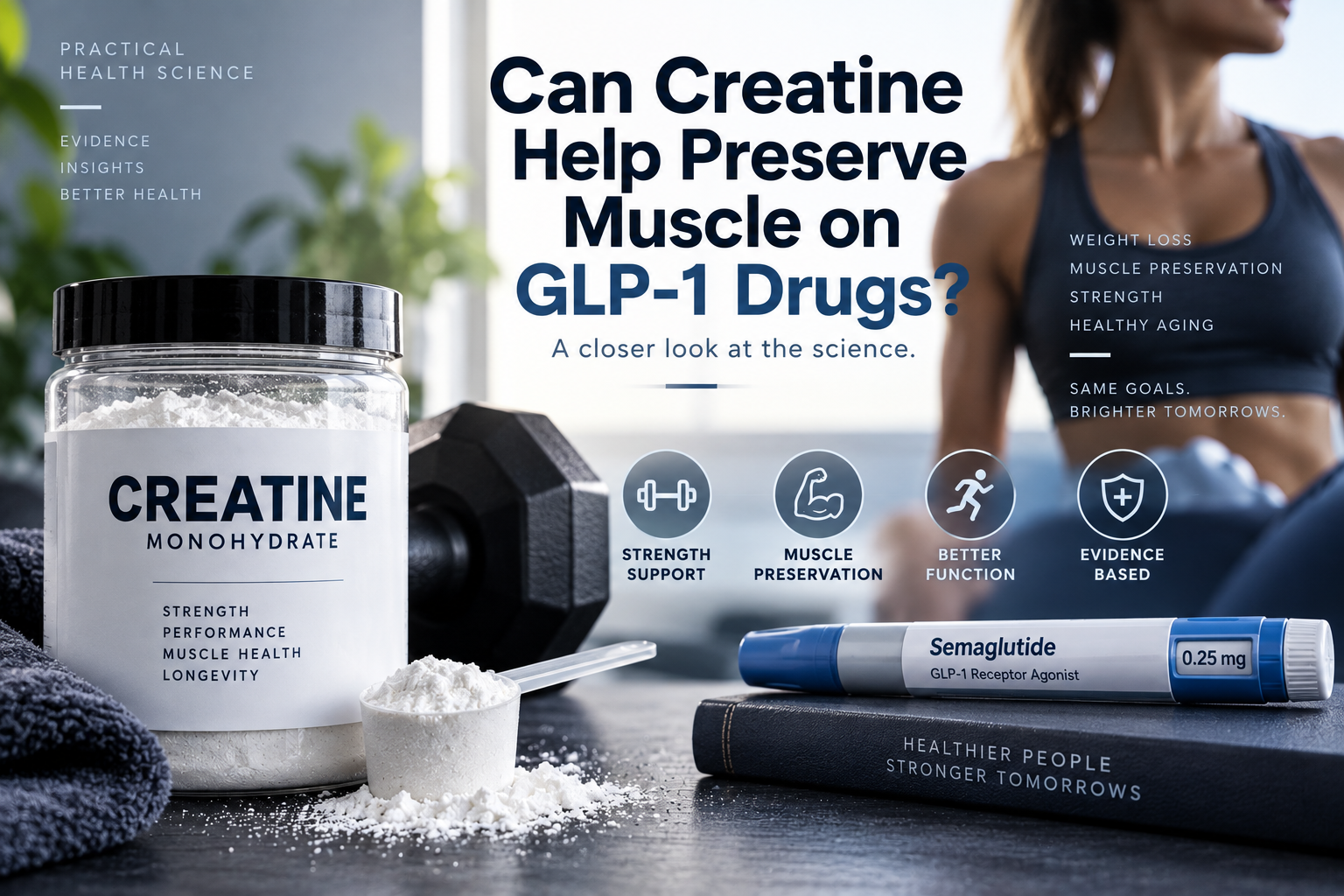
Can Creatine Help Preserve Muscle While Taking GLP 1 Drugs?

Creatine makes biological sense as a muscle support strategy during major weight loss, but direct evidence in people taking GLP 1 medications is still missing.

By Practical Health Science Editorial Team Sep 16, 2026 6 min read
Evidence Strength
Limited

This rating reflects the overall strength and consistency of the available evidence.

Can Creatine Help Preserve Muscle While Taking GLP 1 Drugs?
Quick Answer

Creatine might help support muscle and strength while taking GLP 1 medications, especially when combined with resistance training.

But there is an important limitation:

We do not yet have clinical trials showing that creatine specifically prevents muscle loss caused by GLP 1 based weight loss.

The rationale comes from a different but substantial body of research. Creatine combined with resistance training can improve strength and, in some populations, increase lean mass more than resistance training alone.

That makes creatine an interesting potential addition to adequate protein and strength training during treatment with medications such as semaglutide or tirzepatide.

For now, however, creatine should be viewed as a plausible supporting strategy rather than a proven treatment for GLP 1 related muscle loss.

What the Science Says

GLP 1 based medications can produce substantial reductions in body weight.

Most of that weight comes from fat, which is the intended outcome. But measurements from clinical trials also show reductions in lean mass.

Lean mass is not the same as skeletal muscle. It includes muscle, water, organs, connective tissue, and other fat free tissues.

Still, preserving muscle strength and function during major weight loss is important, particularly for older adults and people who begin treatment with relatively low muscle mass.

Current clinical strategies focus primarily on adequate nutrition, sufficient protein, and resistance exercise.

Creatine is now being discussed as another possible tool.

A comprehensive 2026 review of musculoskeletal preservation during GLP 1 treatment included creatine among several potential supplements. The authors concluded that creatine is a plausible adjunct, but emphasized that the evidence is largely indirect.

In other words, we know quite a lot about creatine and muscle.

We know much less about creatine specifically during GLP 1 treatment.

Why Might Creatine Help During GLP 1 Weight Loss?

Creatine helps replenish phosphocreatine stores within muscle.

Phosphocreatine contributes to rapid ATP regeneration during high intensity muscular activity, including resistance exercise.

This can improve training capacity and strength over time.

That matters because resistance training is one of the most important tools available for preserving muscle during weight loss.

Creatine may therefore help indirectly by allowing people to get more from their strength training.

There is also evidence that creatine supplementation combined with resistance training can increase lean mass.

A 2024 systematic review and meta analysis examined adults younger than 50.

Compared with resistance training alone, adding creatine increased lean body mass by an average of approximately 1.1 kg.

The creatine groups also experienced slightly greater reductions in body fat percentage and fat mass.

This does not mean the same result will occur during GLP 1 treatment, but it explains why researchers are interested in the combination.

What About Older Adults?

The potential role of creatine may be particularly relevant in older adults because maintaining strength becomes increasingly important with age.

A very recent 2026 systematic review examined 11 randomized trials of creatine combined with resistance training in adults aged 60 and older.

Creatine provided a small additional improvement in muscle strength compared with resistance training alone.

However, the pooled effect on muscle mass was not statistically significant.

This is an important update because older meta analyses had suggested clearer increases in lean tissue.

The newer analysis indicates that the strongest current evidence in older adults may be for strength, rather than guaranteed increases in muscle mass.

That distinction is highly relevant to GLP 1 treatment.

Preserving physical function and strength may ultimately matter more than preserving every kilogram measured as lean mass on a body composition scan.

Has Creatine Been Tested With Semaglutide or Tirzepatide?

This is where the evidence gap becomes important.

At present, there is not enough direct clinical evidence showing that people taking semaglutide, tirzepatide, or other GLP 1 based medications preserve more muscle if they also take creatine.

Recent reviews of GLP 1 treatment discuss creatine because the biological rationale and external evidence are promising.

But that is not the same as demonstrating an effect in GLP 1 users.

A proper trial would need to compare groups such as:

GLP 1 treatment plus resistance training

with

GLP 1 treatment plus resistance training and creatine.

Researchers would then need to measure skeletal muscle, strength, physical function, and ideally dietary protein intake over several months.

Until studies like this are available, claims that creatine “prevents Ozempic muscle loss” are premature.

Is Creatine More Important Than Protein?

Probably not.

Protein and creatine do different things.

Dietary protein provides the amino acids needed for muscle protein synthesis.

Creatine primarily supports cellular energy availability and can enhance adaptations to resistance exercise.

During GLP 1 treatment, appetite suppression can make adequate protein intake difficult. Addressing that problem is more fundamental than simply adding creatine.

The most defensible strategy is therefore not:

GLP 1 + creatine

It is closer to:

GLP 1 + adequate nutrition + sufficient protein + resistance training

Creatine can potentially be added to that foundation.

Does Creatine Stop Weight Loss?

Creatine can increase body weight slightly, particularly when supplementation begins.

This is largely related to increased water stored within muscle rather than increased body fat.

That can be confusing for someone using a GLP 1 medication and closely monitoring the scale.

A small increase or temporary plateau after starting creatine does not necessarily mean fat loss has stopped.

This is another reason body weight alone is an incomplete measure of progress.

Waist circumference, body composition, strength, physical function, and metabolic health can provide additional information.

How Much Creatine Is Typically Used?

Most research uses creatine monohydrate.

A common maintenance dose is approximately 3 to 5 grams per day.

A loading phase can increase muscle creatine stores more quickly, but it is not necessary for supplementation to work over time.

There is currently no evidence showing that people taking GLP 1 medications require a different creatine dose.

That means there is little scientific justification for special “GLP 1 creatine protocols” marketed specifically to medication users.

The standard evidence on creatine remains the more reasonable reference point until direct trials become available.

Limitations Summary

The biggest limitation is straightforward.

There are currently no strong clinical trials demonstrating that creatine prevents muscle loss specifically during GLP 1 based weight loss.

Most of the argument comes from creatine research conducted in people who are not taking these medications.

Another limitation is the way muscle is measured.

Many weight loss trials report lean mass using DXA or fat free mass using bioelectrical impedance. Neither measurement is identical to skeletal muscle.

Changes in hydration and glycogen can also influence these measurements, which is especially relevant because creatine itself increases intracellular water.

Finally, maintaining muscle is not simply a supplementation problem.

Age, baseline muscle mass, rate of weight loss, protein intake, physical activity, resistance training, medication dose, and overall energy intake can all influence the outcome.

What This Means in Real Life

Creatine is a reasonable supplement to discuss for someone who is already performing resistance training while losing weight with a GLP 1 medication.

The evidence supporting creatine for strength and training adaptation is much stronger than the evidence supporting creatine specifically for GLP 1 related muscle preservation.

That distinction matters.

Creatine should not replace protein or resistance exercise.

A more evidence based priority would be:

Maintain adequate protein intake.
Perform regular resistance training.
Avoid unnecessarily severe calorie restriction.
Monitor strength and physical function, not just body weight.
Consider creatine as a possible additional tool.

People with kidney disease, complex medical conditions, or concerns about supplementation should discuss creatine with their healthcare professional.

Key Takeaway

Creatine has a strong scientific rationale for supporting strength and training adaptations, which makes it an interesting supplement during GLP 1 based weight loss.

But we do not yet know whether it specifically prevents muscle loss in people taking semaglutide or tirzepatide.

Current evidence supports resistance training and adequate protein more directly.

Creatine may complement those strategies, but it should currently be considered a promising adjunct rather than a proven solution to GLP 1 related muscle loss.

Sources

Effects of resistance training combined with creatine supplementation on muscle strength, physical function, and muscle mass in older adults: a systematic review and three-level meta-analysis
Lingzi Yao, Doudou Yang, Jiajia Gao.. Frontiers in Nutrition. 2026.
Systematic Review DOI: 10.3389/fnut.2026.1919884 PMID: 42712402

Very recent evidence assessing creatine combined with resistance training in adults aged 60 and older. It found a small additional benefit for muscle strength but uncertain effects on muscle mass and physical function.

Lean Mass and Musculoskeletal Preservation in GLP 1 Based Obesity Treatment: Nutrition, Exercise, Supplementation, and Monitoring Strategies.
Roko Šantić, Lovre Martinović, Nikola Pavlović, Doris Rušić, Marko Kumrić, Dinko Martinović, Tina Tičinović Kurir, Joško Božić.. Metabolites. 2026.
Systematic Review DOI: 10.3390/metabo16060364 PMID: 42346344

Most recent directly relevant review assessing lean mass preservation during GLP 1 based obesity treatment. It discusses creatine as a potential adjunct while emphasizing that current support is primarily indirect rather than GLP 1 specific.

The Effect of Creatine Supplementation on Resistance Training Based Changes to Body Composition: A Systematic Review and Meta Analysis.
Imtiaz Desai, Michael A. Wewege, Matthew D. Jones, Briana K. Clifford, Anurag Pandit, Nadeem O. Kaakoush, David Simar, Amanda D. Hagstrom.. Journal of Strength and Conditioning Research. 2024.
Systematic Review DOI: 10.1519/JSC.0000000000004862 PMID: 39074168

Provides quantitative evidence that adding creatine to resistance training can increase lean body mass and modestly improve body composition in adults younger than 50.

Luisa Barana, Michelantonio De Fano, Massimiliano Cavallo, Marcello Manco, Deborah Prete, Carmine Giuseppe Fanelli, Francesca Porcellati, Roberto Pippi.
Nutrition and Physical Activity in Optimizing Weight Loss and Lean Mass Preservation in the Incretin Based Medications Era: A Narrative Review.. Nutrients. 2026.
Systematic Review DOI: 10.3390/nu18010131 PMID: 41515247

Reviews nutrition, supplementation, resistance exercise, and physical activity strategies for preserving lean mass during treatment with incretin based medications.

Creatine supplementation for older adults: Focus on sarcopenia, osteoporosis, frailty and cachexia.
Darren G. Candow, Scott C. Forbes, Sergej M. Ostojic, Eric S. Rawson, Richard B. Kreider.. Bone. 2019.
Systematic Review DOI: 10.1016/j.bone.2019.07.008 PMID: 31306799

Older but useful foundational source explaining the biological rationale and clinical research behind creatine as a potential strategy for age related loss of muscle and function.

Medical disclaimer: This article is for educational purposes only and does not provide medical advice, diagnosis, or treatment. Always consult a qualified healthcare professional for personal medical decisions.

Related Reading

Continue with articles connected to this topic.

Metabolic Health Myth Check Evidence: Moderate

Do GLP-1 Weight Loss Drugs Cause Muscle Loss?

GLP-1 weight-loss drugs can reduce lean mass along with fat. But most of the weight lost is fat, and current evidence does not show that lean-mass loss automatically translates into muscle weakness or pathological muscle wasting.

Practical Health Science Editorial Team 6 min read Aug 31, 2026
Metabolic Health Evidence Brief Evidence: Limited

Can Creatine Help Preserve Muscle While Taking GLP 1 Drugs?

Creatine can support strength and lean mass when combined with resistance training, making it an interesting option during GLP 1 weight loss. But does it actually prevent muscle loss in people taking semaglutide or tirzepatide?

Practical Health Science Editorial Team 6 min read Sep 16, 2026