
Can GLP-1 Drugs Cause Blindness? What the New FDA Warning Really Means

The FDA now warns of a rare optic nerve condition with GLP-1 drugs. The signal appears real enough to take seriously, but the absolute risk is small and “blindness” oversimplifies the evidence.

By Practical Health Science Editorial Team Nov 11, 2026 7 min read
Evidence Strength
Moderate

This rating reflects the overall strength and consistency of the available evidence.

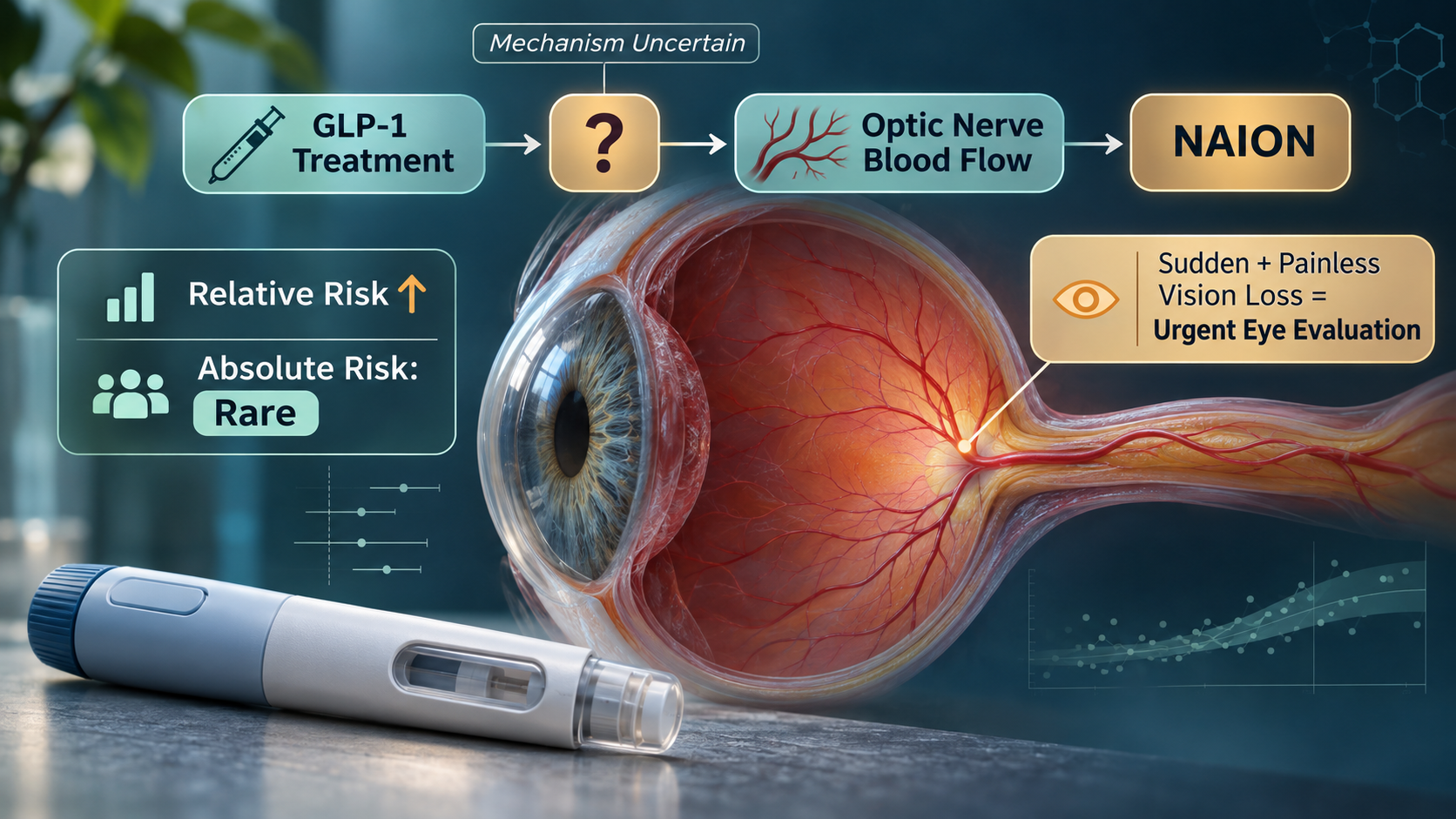
GLP-1 injection pen beside an optic nerve illustration explaining the rare potential risk of NAION and vision loss.
Quick Answer

GLP-1 drugs may slightly increase the risk of a rare optic nerve condition called non-arteritic anterior ischemic optic neuropathy, or NAION. But saying that these drugs simply “cause blindness” is misleading.

On November 9, 2026, the U.S. Food and Drug Administration required manufacturers of all GLP-1 receptor agonist medications to add a warning about a potential increased risk of NAION. This includes commonly used medications containing semaglutide and tirzepatide, among others.

NAION occurs when blood flow to part of the optic nerve is disrupted. It usually causes sudden, painless loss of vision in one eye, and some of that vision loss can be permanent.

The FDA's analysis of 126 randomized trials found:

6.4 NAION cases per 100,000 person-years with GLP-1 drugs

3.8 cases per 100,000 person-years with comparator treatments

A separate 2026 meta-analysis involving more than 1.5 million patients estimated about a 70% higher relative risk, but the absolute increase was only about 0.037 percentage points, corresponding to roughly one additional case for every 2,700 treated people in the pooled analysis.

So the current evidence supports a rare safety signal, not the idea that vision loss is a common consequence of GLP-1 treatment.

What the Science Says

The concern began with observational reports involving semaglutide, the active ingredient in Ozempic, Wegovy, and Rybelsus.

A widely discussed 2024 study from a neuro-ophthalmology center found substantially more NAION among patients prescribed semaglutide than among comparison patients. However, the study came from a specialized referral population and could not establish causation.

Larger studies that followed produced more modest and sometimes conflicting results.

A Danish-Norwegian national cohort found approximately a 2.8-fold higher relative risk of NAION among people with type 2 diabetes starting semaglutide compared with SGLT2 inhibitors, but the excess absolute rate was only about 1.4 cases per 10,000 person-years.

A large 2025 U.S. analysis found a much smaller association, while another large database study found no increased NAION risk at all.

By 2026, however, the evidence had become consistent enough overall for both professional societies and regulators to take the signal seriously. The American Academy of Ophthalmology and North American Neuro-Ophthalmology Society concluded that there may be a small increased risk, particularly with semaglutide, while emphasizing that causality has not been established.

What Is NAION, and Is It the Same as “Going Blind”?

Not exactly.

NAION is an ischemic injury to the optic nerve, the structure that carries visual information from the eye to the brain.

Typical symptoms include:

  • sudden painless vision loss in one eye

  • a missing area or blind spot in the visual field

  • blurred or hazy vision

  • reduced color perception

  • loss of central or peripheral vision

Vision loss can be permanent, but the severity varies. It does not automatically mean complete blindness in both eyes.

The FDA notes that established or suspected NAION risk factors include diabetes, high blood pressure, smoking, sleep apnea, anemia, and kidney disease. A previous episode of NAION in one eye also increases the risk of the other eye eventually being affected.

This overlap creates a major scientific problem.

Many people prescribed GLP-1 drugs already have diabetes, obesity, hypertension, sleep apnea, or cardiovascular disease—the same conditions associated with NAION.

Separating the effect of the medication from the health profile of the person taking it is therefore difficult.


How Big Is the Risk in Absolute Terms?

This is where headlines about “blindness risk” can become misleading.

The 2026 meta-analysis of 15 longitudinal studies involving more than 1.5 million patients found an odds ratio of 1.70 for NAION with GLP-1 receptor agonists.

That sounds large when expressed as a relative increase.

But NAION itself is rare.

The pooled absolute risk among GLP-1 users was approximately 0.09%, with an estimated absolute excess risk of 0.037%.

FDA's own randomized-trial analysis produced even smaller absolute numbers: 10 probable NAION events among GLP-1-treated patients versus five among comparator-treated patients across more than 288,000 person-years of exposure.

Real-world studies produce somewhat higher estimates because people with diabetes often already carry substantial vascular risk.

For example, a 2026 U.S. Veterans study found cumulative NAION risks of 0.29% with semaglutide versus 0.13% with SGLT2 inhibitors over a median follow-up of 2.1 years.

That difference deserves attention.

But it is very different from saying:

“GLP-1 drugs commonly cause blindness.”

They do not.


Is This a Semaglutide Problem or a GLP-1 Class Problem?

This is one of the most important unresolved questions.

Most published evidence has focused on semaglutide.

In June 2025, the European Medicines Agency concluded that NAION should be considered a very rare adverse effect of semaglutide, potentially affecting up to 1 in 10,000 users, and recommended updating product information for Ozempic, Wegovy, and Rybelsus.

The 2026 AAO/NANOS consensus statement was more cautious about extending the finding to every GLP-1 drug. It concluded that evidence for other drugs in the class remained inadequate.

The FDA has now taken a broader regulatory position.

On November 9, 2026, it required NAION warnings for all currently marketed GLP-1 receptor agonists, including the dual GIP/GLP-1 drug tirzepatide. FDA reported that NAION cases had been observed across currently marketed products and that its pooled clinical-trial analysis supported a potential class-wide risk.

So the distinction is:

Scientific evidence is strongest for semaglutide.
The current U.S. regulatory warning applies to the entire GLP-1 RA class.


What About Diabetic Retinopathy?

NAION should not be confused with another eye-related issue already discussed with GLP-1 therapy: diabetic retinopathy.

These are different conditions.

Diabetic retinopathy involves damage to retinal blood vessels caused by diabetes.

NAION involves ischemic injury to the optic nerve.

In the SUSTAIN-6 trial, semaglutide was associated with more diabetic-retinopathy complications than placebo, especially among patients who already had retinopathy and experienced rapid reductions in HbA1c.

More recent analyses suggest this may partly represent the well-known phenomenon of temporary early worsening of diabetic retinopathy when glucose improves very rapidly, rather than direct retinal toxicity from GLP-1 drugs.

The American Academy of Ophthalmology's 2026 review concluded that evidence does not consistently show that GLP-1 drugs themselves worsen diabetic retinopathy and recommends appropriate retinal monitoring in people with diabetes starting treatment.

So “GLP-1 drugs and eye problems” is not one single safety issue.

Limitations Summary

The main limitation is that NAION is so rare that even very large clinical trials record only a handful of events.

Observational database studies can include millions of people, but they introduce different problems.

People receiving semaglutide may differ from comparison groups in:

diabetes severity

obesity

sleep apnea

cardiovascular disease

kidney disease

blood-pressure control

access to eye care

Different studies also use different comparison drugs and definitions of NAION.

That helps explain why some analyses report a two- to three-fold increase while others find little or no association.

Finally, FDA reported that animal studies have not identified a convincing mechanism explaining why GLP-1 receptor activation would directly cause NAION.

What This Means in Real Life

The new warning is a reason for awareness, not panic.

People taking a GLP-1 medication should not automatically stop treatment because of this safety signal.

These drugs can provide substantial benefits for obesity, diabetes, cardiovascular disease, kidney disease, and other conditions. For many patients, those established benefits are much larger than the absolute risk of NAION.

The AAO and NANOS specifically recommend shared decision-making rather than automatically stopping GLP-1 therapy whenever concern about NAION arises.

One situation is different:

Sudden, painless loss of vision in one eye requires urgent medical evaluation.

The FDA advises patients to report sudden vision loss, missing areas of vision, or other major visual changes immediately. If NAION is suspected, prompt ophthalmologic assessment is appropriate.

For someone who has already experienced NAION, the decision about continuing a GLP-1 medication becomes more individualized and should involve the prescribing clinician and eye specialist.

Key Takeaway

GLP-1 drugs are now officially linked to a potential increased risk of NAION, a rare optic nerve condition that can cause permanent vision loss.

The new FDA warning should be taken seriously.

But the absolute risk remains small, the evidence is strongest for semaglutide, and scientists have not yet demonstrated a clear causal mechanism.

So the most accurate conclusion is not:

“Ozempic and other GLP-1 drugs cause blindness.”

It is:

“GLP-1 drugs may modestly increase the risk of a rare, potentially serious form of optic nerve injury and that risk must be weighed against their well-established health benefits.”

Sources

FDA Requires Safety Labeling Changes for Glucagon-Like Peptide-1 Receptor Agonists (GLP-1 RAs) Due to Potential Increased Risk of Rare But Serious Eye Condition
U.S. Food and Drug Administration.. FDA Drug Safety Communication. 2026.
Regulatory Document

Most current U.S. regulatory assessment. FDA reviewed clinical trials, real-world Sentinel data, postmarketing reports, observational research, and animal evidence and required NAION warnings for all GLP-1 receptor agonists. FDA's analysis of 126 randomized trials found 6.4 versus 3.8 NAION events per 100,000 person-years.

Association Between GLP-1 Receptor Agonists and Ischemic Optic Neuropathy: A Meta-analysis.
Nogueira A, Rassi TNO, Iqbal A, Felix N, Alghaith O, Khan A, Rassi N, Maia M, Moura FA. Diabetes Care. 2026.
Meta Analysis DOI: 10.2337/dc25-1238 PMID: 41498755

Major current quantitative synthesis involving 15 studies and more than 1.5 million patients. Found higher NAION risk with GLP-1 RAs (OR 1.70) but a small absolute risk difference of 0.037%.

Glucagon-Like Peptide-1 Receptor Agonists and the Risk of Non-Arteritic Anterior Ischemic Optic Neuropathy: A Consensus Statement by the North American Neuro-Ophthalmology Society and the American Academy of Ophthalmology.
DeParis SW, Oke I, Gaier ED, Moss HE, MacIntosh PW, Gilbert AL, Dinkin MJ, Chen JJ.. Ophthalmology. 2026.
Regulatory Document DOI: 10.1016/j.ophtha.2026.04.008 PMID: 42132708

Current specialist interpretation of the evidence. Concludes that a small increased NAION risk, particularly with semaglutide, is possible but causality has not been proven. Recommends individualized risk-benefit discussion rather than automatic discontinuation.

Use of semaglutide and risk of non-arteritic anterior ischemic optic neuropathy: A Danish-Norwegian cohort study.
Simonsen E, Lund LC, Ernst MT, Hjellvik V, Hegedüs L, Hamann S, Jørstad ØK, Gulseth HL, Karlstad Ø, Pottegård A.. Diabetes, Obesity and Metabolism.. 2025.
Observational Study DOI: 10.1111/dom.16316 PMID: 40098249

Important European real-world evidence comparing semaglutide with SGLT2 inhibitors in people with type 2 diabetes. Found an adjusted HR of 2.81 but a low absolute excess rate of approximately 1.41 cases per 10,000 person-years.

New-Onset Nonarteritic Anterior Ischemic Optic Neuropathy and Initiators of Semaglutide in US Veterans With Type 2 Diabetes.
Heberer K, Bress AP, Cogill S, Maldonado AI, Kim SH, Nallamshetty S, Chen YQ, Shih MC, Lynch JA, Lee JS.. JAMA Ophthalmology.. 2026.
Observational Study DOI: 10.1001/jamaophthalmol.2025.6262 PMID: 41678180

Contemporary U.S. evidence comparing semaglutide with SGLT2 inhibitors. Found approximately 2.3-fold higher relative risk, with cumulative risks of 0.29% versus 0.13% over a median 2.1 years.

Semaglutide and Nonarteritic Anterior Ischemic Optic Neuropathy.
Cai CX, Hribar M, Baxter S, Goetz K, Swaminathan SS, Flowers A, Brown EN, Toy B, Xu B, Chen J, Chen A, Wang S, Lee C, Leng T, Ehrlich JR, Barkmeier A, Armbrust KR, Boland MV, Dorr D, Boyce D, Alshammari T, Swerdel J, Suchard MA, Schuemie M, Bu F, Sena AG, Hripcsak G, Nishimura A, Nagy P, Falconer T, DuVall SL, Matheny M, Viernes B, O'Brien W, Zhang L, Martin B, Westlund E, Mathioudakis N, Fan R, Wilcox A, Lai A, Stocking JC, Takkouche S, Lee LH, Xie Y, Humes I, McCoy DB, Adibuzzaman M, Areaux RG Jr, Rojas-Carabali W, Brash J, Lee DA, Weiskopf NG, Mawn L, Agrawal R, Morgan-Cooper H, Desai P, Ryan PB. . JAMA Ophthalmology. . 2025.
Observational Study DOI: 10.1001/jamaophthalmol.2024.6555 PMID: 39976940

Analysis across 14 healthcare databases involving a source population of approximately 37 million adults with type 2 diabetes. Found a small increased relative incidence of NAION with semaglutide, smaller than the initial 2024 signal.

he Effect of Semaglutide and GLP-1 RAs on Risk of Nonarteritic Anterior Ischemic Optic Neuropathy.
Abbass NJ, Nahlawi R, Shaia JK, Allan KC, Kaelber DC, Talcott KE, Singh RP.. American Journal of Ophthalmology. 2025.
Observational Study DOI: 10.1016/j.ajo.2025.02.025 PMID: 40015592

Important counterbalancing evidence. Found no significant increase in NAION among semaglutide or broader GLP-1 RA users compared with matched controls, demonstrating that observational findings have not been completely consistent.

Risk of Nonarteritic Anterior Ischemic Optic Neuropathy in Patients Prescribed Semaglutide
Hathaway JT, Shah MP, Hathaway DB, Zekavat SM, Krasniqi D, Gittinger JW Jr, Cestari D, Mallery R, Abbasi B, Bouffard M, Chwalisz BK, Estrela T, Rizzo JF 3rd.. JAMA Ophthalmology.. 2024.
Observational Study DOI: 10.1001/jamaophthalmol.2024.2296 PMID: 38958939

Initial influential study that triggered major scientific and regulatory investigation of the potential semaglutide-NAION association. Reported large relative-risk estimates but had important referral-population and observational-design limitations.

PRAC concludes eye condition NAION is a very rare side effect of semaglutide medicines Ozempic, Rybelsus and Wegovy.
European Medicines Agency, Pharmacovigilance Risk Assessment Committee.. European Medicines Agency.. 2025.
Regulatory Document

Concluded that NAION should be included in semaglutide product information as a very rare adverse effect, potentially affecting up to 1 in 10,000 users.

Medical disclaimer: This article is for educational purposes only and does not provide medical advice, diagnosis, or treatment. Always consult a qualified healthcare professional for personal medical decisions.

Related Reading

Continue with articles connected to this topic.

Metabolic Health Myth Check Evidence: Moderate

Do GLP-1 Weight Loss Drugs Cause Muscle Loss?

GLP-1 weight-loss drugs can reduce lean mass along with fat. But most of the weight lost is fat, and current evidence does not show that lean-mass loss automatically translates into muscle weakness or pathological muscle wasting.

Practical Health Science Editorial Team 6 min read Aug 31, 2026
Metabolic Health Evidence Brief Evidence: Limited

Can Creatine Help Preserve Muscle While Taking GLP 1 Drugs?

Creatine can support strength and lean mass when combined with resistance training, making it an interesting option during GLP 1 weight loss. But does it actually prevent muscle loss in people taking semaglutide or tirzepatide?

Practical Health Science Editorial Team 6 min read Sep 16, 2026